
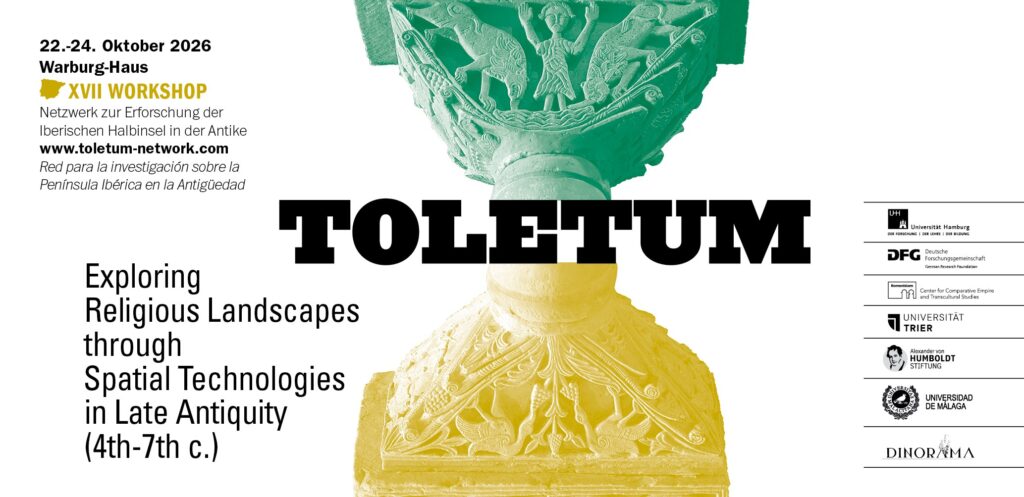
TOLETUM lädt ein: der 17. Workshop findet vom 22. bis zum 24. Oktober 2026 im Hamburger Warburg-Haus statt, und zwar in Zusammenarbeit mit Prof. Dr. José Carlos López Gómez, der sich zur Zeit als Stipendiat der Alexander von Humboldt – Stiftung am RomanIslam – Center for Comparative Empire and Transcultural Studies aufhält (Universität Hamburg – Universidad de Málaga).
Ein Höhepunkt – die Eröffnungsvorträge am 22. Oktober 2026:
17:30 Uhr, Ignasi Grau (Universidad de Alicante), Religious landscapes through the lens of geospatial technologies. Some proposals for analysis and interpretation
18:15 Uhr, Giorgos Papantoniou (Trinity College Dublin) – Athanasios Vionis (University of Cyprus), Unlocking Late Antique Sacred Landscapes in Cyprus: Spatial and digital approaches in the Xeros River Valley and Beyond
19:00 Uhr, Katerina Ragkou (Philipps Universität Marburg), Sacralizing the Periphery: The Basilica of Athena Itonia and the Limits of Ecclesiastical Connectivity in Late Antique Thessaly
 weitere am 23. Oktober,
um 9:00 Uhr, Pieter Houten (University of Nottingham), In View of the Cross: The Religious Geography of Power in Late Antique Baetica
oder um 18:15 Uhr, Donato Sitaro
(Università degli Studi di Napoli Federico II), Periphery, Whose periphery? The Western British Ecclesiastical Landscape within the Atlantic Koiné (IV-VI c.)
sowie am 24. Oktober 2026,
um 9:30 Uhr, Pablo Rodríguez Valdés (Universidad Carlos III de Madrid), Mapping Reappropriation: Spatial and Digital Analysis of Elite and Subaltern Sacred Landscapes in Late Antique Crete
Veranstaltungsort: Warburg-Haus, Heilwigstr. 116, 20249 Hamburg
Programm: Toletum XVII, 10.2026 (pdf)
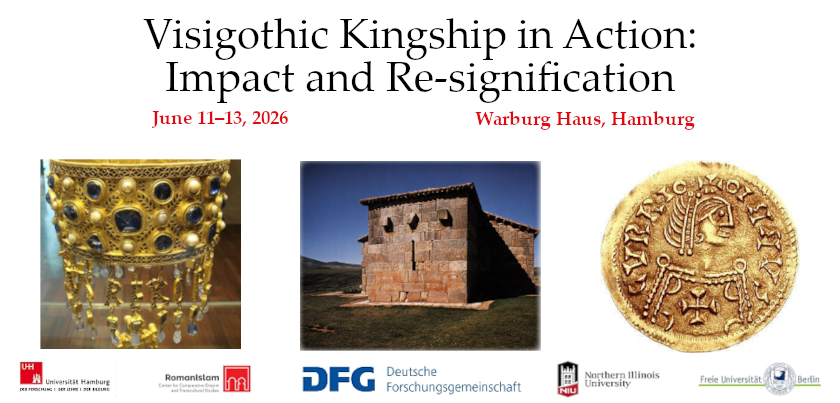 Internationales Kolloquium. Aus dem Ankündigungstext der Veranstalter: «The study of Visigothic kingship has a long and respectable tradition. On the one hand, scholars have scrutinized the numerous normative texts from the Visigothic kingdom to recover the legal foundations of kingship and the institutions surrounding kings (court, councils, army). As a corollary, a robust series of studies that combine normative and historical texts have explored the interactions between kings and magnates and kings and bishops in what can be described as the kingdom’s “high politics.” On the other hand, scholars have combined the study of normative texts with theological treatises or descriptions of rituals to discuss cultural traditions of the post-imperial world. As a result, Visigothic kingship has been presented as having evolved from a supposed ancestral form of Gothic or Germanic kingship, as resulting from the transformation of Roman rulership, or as having developed Christian ideas of government.