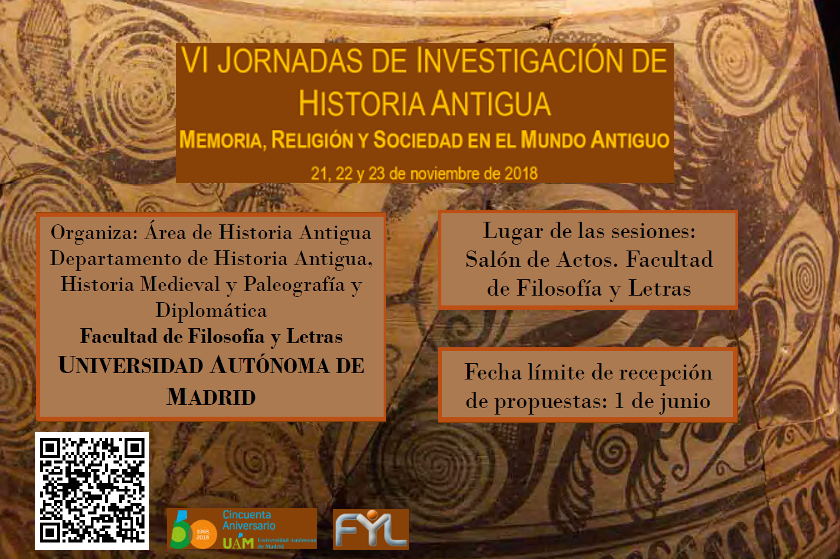
De la introducción por parte de los organizadores: „(…) Estas Jornadas se concibieron con el objetivo de que fueran un espacio de debate e intercambio de ideas entre doctorandos y jóvenes doctores en torno a temas candentes de la investigación actual sobre el Mundo antiguo. (…)
En esta ocasión, queremos adentrarnos desde una perspectiva multifocal en uno de los aspectos más fascinantes –y acaso más complejos– de nuestra disciplina. Según se desprende de los estudios históricos y antropológicos de las últimas décadas, memoria y religión pueden concebirse como construcciones culturales, sociales por antonomasia, coadyuvantes en el proceso de creación y recreación de una cosmogonía compartida en torno a la que la sociedad se organiza como tal. Si entendemos que la memoria social comprende aquellos discursos tendentes a construir un pasado colectivo negociado que dé sentido a nuestro presente, y que la religión aporta al ser humano una explicación de todos aquellos intersticios de su mundo que escapan a su experiencia empírica, colegiremos que religión y memoria, memoria y religión, se revelan ante el historiador como vías excepcionales de aproximación a las sociedades antiguas, a su manera de estructurarse y de concebir el mundo en el que estaban insertas. (…).“
Con ponencias (entre otras) de:
Jorge García Cardiel (Universidad Autónoma de Madrid), La difícil negociación de la memoria: tumbas y depósitos votivos en la Albufereta de Alicante (ss. III-II a.C.)
Cristina García García (Universidad Autónoma de Madrid), Creación y reelaboración de un pasado mítico en la Macedonia argéada
Rubén Escorihuela Martínez (Universidad de Zaragoza), Identidad y control en los signa militaria: el poder de la imagen en el ejército republicano
Esther Sánchez Medina (Universidad Autónoma de Madrid), Genoveva de París: conversión y memoria de la realeza franca
Nathalie Klinck (Universität Hamburg), «Christianus(a) sum” – Northern Africa and its martyres. The veneration of saints and its function in early Christianity
del 21 al 23 de noviembre de 2018
Organisación: Adolfo Domínguez Monedero, Esther Sánchez Medina y Jorge García Cardiel – Área de Historia antigua, Departamento de Historia antigua, Historia medieval y Paleografía y Diplomática, Universidad Autónoma de Madrid
Lugar: Salón de Actos, Facultad de Filosofía y Letras, Universidad Autónoma de Madrid
Programa: Memoria, religión y sociedad, Madrid 11.2018

 Además, hay que destacar: – el viernes, 26 de octubre, a las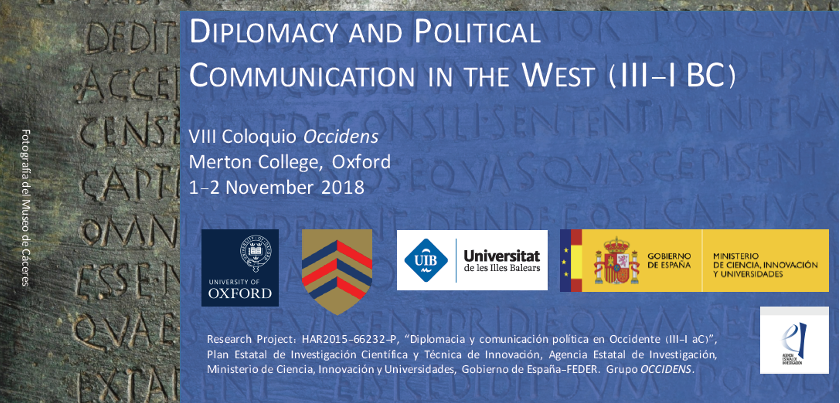
 Organisación: Enrique García Riaza (Universitat de les Illes Balears) und Jonathan Prag (Merton College, Oxford) / Proyecto HAR2015-66232: “Diplomacia y comunicación política en Occidente, III-I a. C.)” HAR2011-27782